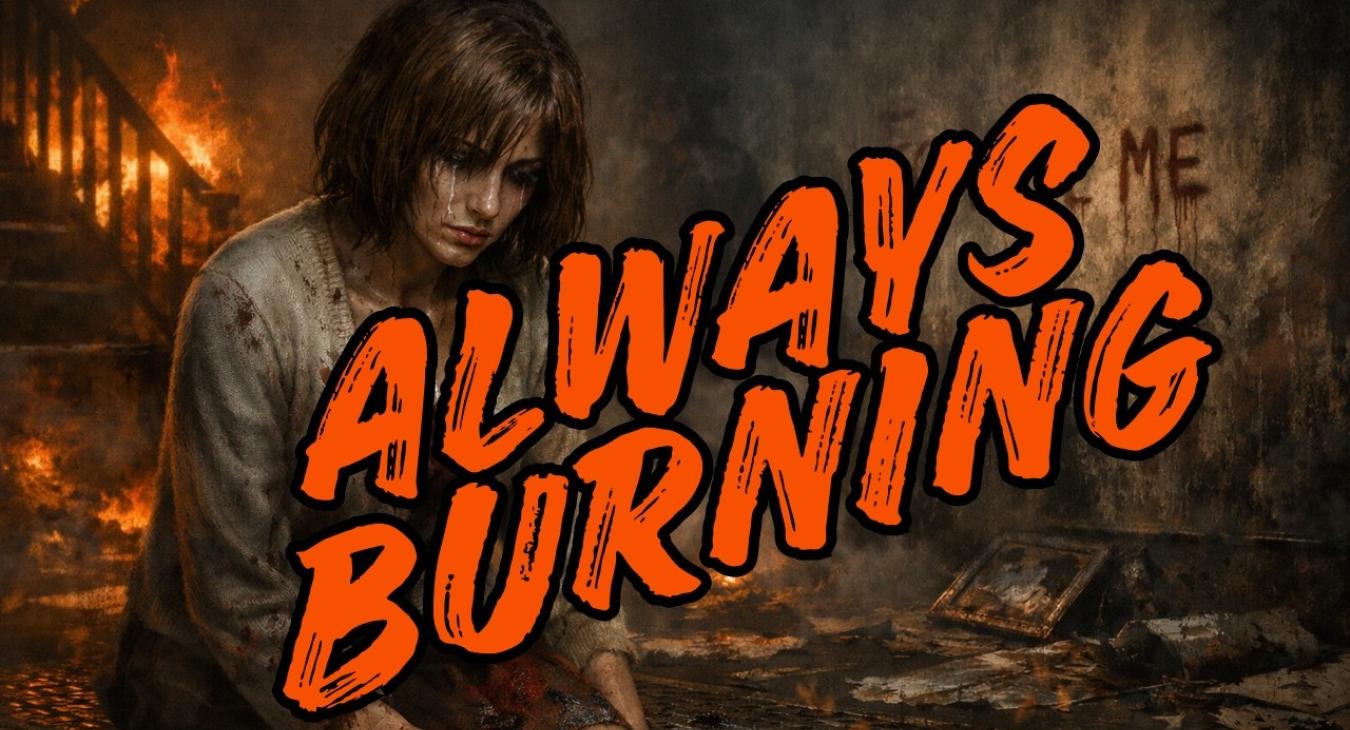
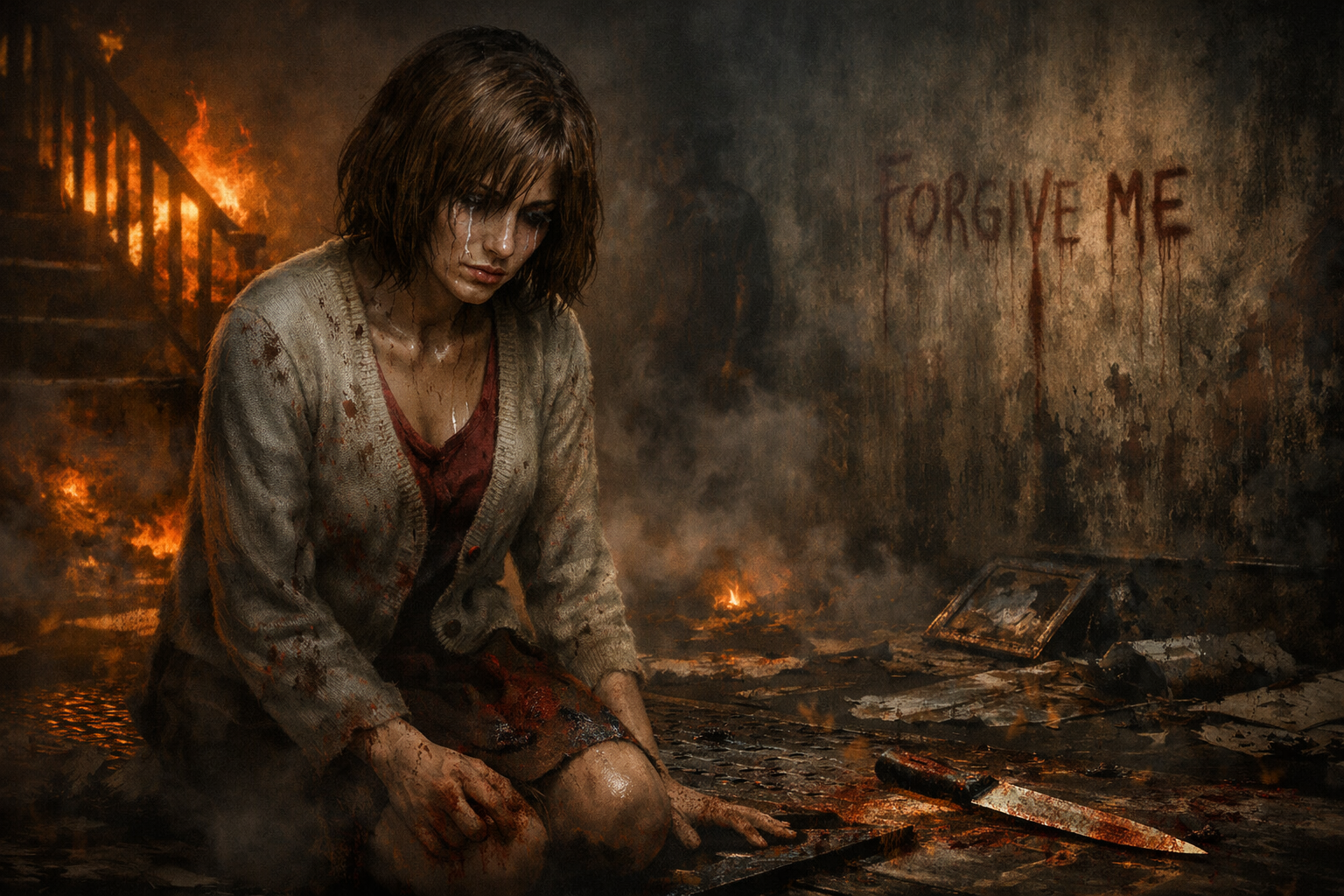
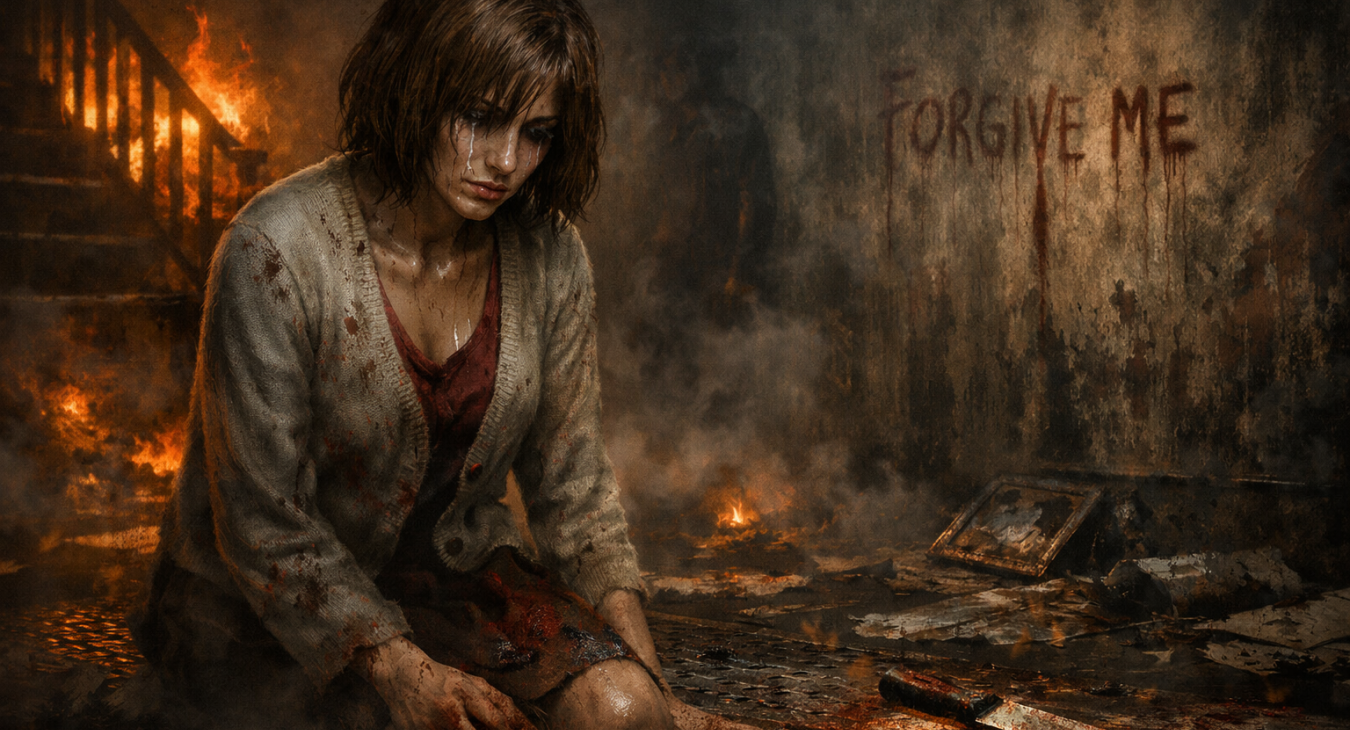
There are monsters in Silent Hill 2, but Angela Orosco was never one of them.
Trigger warning: This article deals with themes of child s*xual abuse
She appears in the cemetery at the start of the game, fragile, distant, almost ghost-like. She is looking for her mother. That detail matters. Because underneath everything else, the knife she clutches, the trembling voice, the haunted eyes, Angela is still a daughter hoping someone will come and save her.
Her backstory is never laid out neatly. It comes in fragments, surfacing through brief conversations and the warped architecture of the town itself. What we learn is devastating. She was sexually abused by her father. There are suggestions her brother was involved. Her mother knew, or at the very least failed to protect her. Eventually, Angela killed her father. Possibly her brother too. And then she came to Silent Hill.
Silent Hill doesn't just punish those who arrive. It reflects them. It reaches into their psyche and gives form to what is buried there. James Sunderland sees guilt. Eddie sees humiliation and rage. Angela sees fire. Always fire.
Shame, guilt, and the inversion of truth
Shame is at the centre of her story, and it is worth being precise about that word, because shame and guilt are not the same thing. Guilt says, I did something wrong. Shame says, I am something wrong. Survivors of childhood abuse often arrive at shame through a desperate attempt to make sense of the world. If a father, someone whose entire function is protection, causes this much harm, the child's mind searches for an explanation. And the explanation so often lands on is a deficiency in itself. Not in him. In her.
Angela did not cause what happened to her. But every interaction James has with her suggests a woman who has completely internalised the opposite belief. She deflects, apologises, speaks about her own suffering in fragments, as though she doesn't quite have the right to say it plainly. Shame collapses language. It shrinks the self. And long before someone finds the courage to look for counselling, they may have spent years convinced their story is too damaged to be heard.
The mother who never came
Her mother is a ghost within an already haunted narrative. Angela travels to Silent Hill because she believes her mother might be there. After everything, she is still searching for her. That longing reflects something many survivors carry, the aching wish that the parent who didn't initiate the abuse would have chosen to stop it. When they don't, the wound cuts twice, once from the abuse, once from the silence of the person who might have intervened.
When rescue doesn't come, abandonment often turns inward. If the people who were supposed to protect you decided you weren't worth it, the conclusion feels inevitable. You are not worth protecting. Angela's posture, her tone, the exhausted way she carries herself, all of it speaks of someone who stopped expecting anything different long ago.
The Abstract Daddy
The Abstract Daddy, the creature James fights on Angela's behalf, is perhaps the most viscerally symbolic monster in a game full of them. A suffocating mass pinning down a smaller, trapped figure. The horror is not subtle, and it isn't meant to be.
What is striking is what happens after James defeats it. Angela doesn't feel relief. She feels exposed. This rings true for many survivors. The moment the truth is finally named can bring not only relief but also a terrifying vulnerability. Because once it is real, it can no longer be quietly contained. Trauma-informed support, whether in person or through online counselling, understands this. Creating safety always comes before disclosure.
How to deal with the shame
Throughout the game Angela oscillates between anger and collapse, self-blaming, emotionally exhausted. In her final scene, the staircase is engulfed in flames. She says it is always like this for her. Always burning. That line captures chronic shame with an accuracy that is almost clinical. Not an occasional crisis, but a permanent background heat, a settled belief that you are beyond repair.
James tries to reach her. He tells her she is the same as him. That she is not alone. But Angela rejects the comparison. In her mind there is no shared humanity, only her particular contamination.
She walks up the burning staircase and disappears. Whether interpreted as suicide or surrender, the meaning is clear. Angela could not imagine a future on the other side of her shame. Silent Hill showed her exactly what she already believed about herself, and she had nothing with which to argue back.
Her ending is not inevitable. It is a portrait of what happens when trauma is left entirely alone in the dark, when there is no space in which the truth can be spoken, no steady presence to hold it, no voice to say clearly, what happened to you was abuse. It was not your fault.
That shift, from "this is what I am" to "this is what happened to me," is one of the most significant things trauma therapy works toward. For many people the first step is simply finding someone to talk to. Searching for a counsellor near me, or looking into online counselling for the first time, can feel enormous when shame is telling you that you won't be believed. But that is precisely what shame does. It mistakes itself for the truth.
Angela Orosco's tragedy is that she never had a space where her story could be held without distortion. Silent Hill 2 endures as one of the most psychologically honest portrayals of trauma in any medium not because its monsters are frightening, but because its most devastating horror is entirely human.
We see her clearly, even when she cannot see herself. That clarity, being truly seen, is not nothing. It is, in fact, exactly where healing begins.
George Papachristodoulou