
"People say men don't talk, well that's bullshit."
If you've ever wondered why your husband shuts down when you ask how he's doing, why your son says 'I'm fine' when he's clearly not, or why your friend disappears for weeks before quietly mentioning he's been struggling, you're not alone. Men's mental health is in crisis. In the UK, men account for around three out of four of all suicides. In the US, the rate is close to four times higher in men than in women. And yet the dominant cultural message keeps insisting men simply need to open up and talk more.
That advice isn't wrong, but it's so incomplete that it often makes the problem worse. There are two main reasons men don't talk about their mental health to their partners, families, or going to therapy, and only one of them is the one we keep hearing about.
When men do try to talk, they often aren't really heard
This is the reason almost no one mentions, and arguably it's the bigger one, and it’s something I keep hearing men mentioning.
A growing body of research challenges the assumption that men are uniformly silent stoics. A 2022 peer-reviewed focus group study published in PLOS ONE was titled, using participants' own words, "People say men don't talk, well that's bullshit." Researchers at McGill University have argued that the popular "toxic masculinity" explanation is over simplistic for such a complex matter, and that many men with mental health challenges have in fact tried to reach out, only to find an unresponsive or indifferent audience.
The cultural script assumes there's an abundance of competent, empathic listeners waiting for men whenever they're ready to open up. The evidence suggests otherwise.
When a man tentatively shares that he's struggling, the conversation often gets hijacked. He's told to "stay strong for the kids." His pain is compared unfavourably to someone else's. He's given solutions before he's finished speaking. He's met with awkward silence, or worse, told he's being "too sensitive." Sometimes his disclosure even get used against him in a later argument.
Each of these experiences teaches him the same lesson. Opening up is not safe. Over time, men internalise the message that their struggles don't matter, and the pain goes underground.
What does that underground pain look like? Often, not what we expect. It comes out sideways, as irritability, drinking, overworking, withdrawing from the people who love them, or angry outbursts that feel out of proportion. The struggle is being signalled constantly. It's just not being signalled in a form most people have been trained to recognise as a request to listen.
Boys are trained early to disconnect from their inner lives
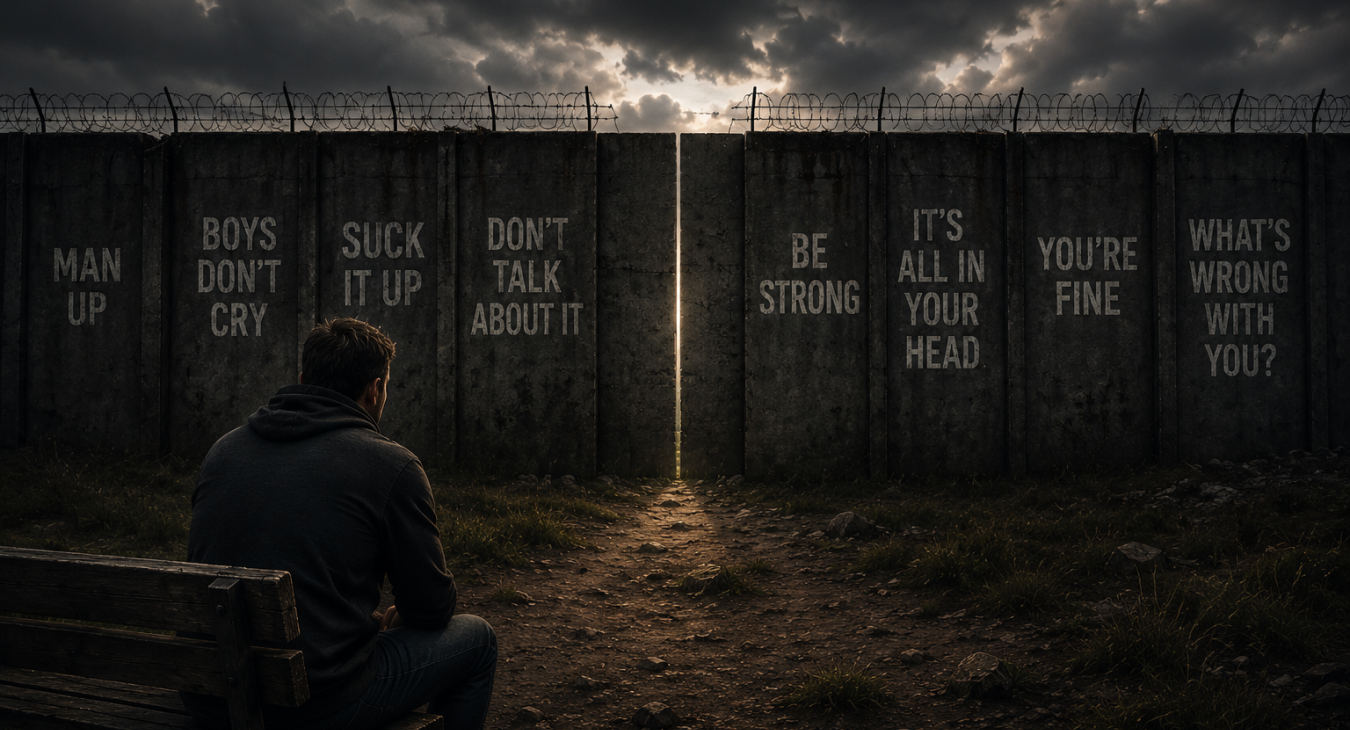
The second reason is the one we hear about more often, but it's usually over simplified. Telling a man to "just be vulnerable" assumes vulnerability is a switch he can flip. For most men, it isn't because they were taught, often before they could form lasting memories, to switch it off.
Boys learn early that crying gets mocked. Fear gets called weakness. Tenderness gets called soft. "Man up." "Don't be a girl." "Boys don’t cry." The boy doesn't just learn to hide his feelings from others. He learns to hide them from himself. By adulthood, many men genuinely don't have language for what's happening inside them. Ask a man who's quietly drowning "what are you feeling?" and you may get a "I don't know," if you are lucky enough. And they are not being avoidant.
This is why male depression so often hides in plain sight. A 2024 study of 1,400 German men and a major systematic review both confirm what clinicians have long observed. Adherence to traditional masculine norms suppresses help seeking, because emotional self disclosure has been coded as unmanly. Men are also more likely to present with physical symptoms like exhaustion, headaches, and insomnia, or externalised behaviours like anger, substance use, and risk taking, rather than the sadness and tearfulness that medical professionals are trained to flag. A man can be severely depressed and to those around him, he may look like just being a dick lately.
The feedback loop that keeps men silent
Here's the part that matters most. These two reasons aren't separate. They feed each other.
A man's internal reluctance to talk is reinforced every time a rare attempt at disclosure lands badly. And those attempts land badly partly because no one has been taught what to do when a man actually does open up, so even well meaning partners and family members mess it up. The man retreats further. The next attempt is even more tentative, even more disguised, even harder to read. The cycle carries on for years, even decades, until it shows up as a divorce, an addiction, a heart attack, or death by suicide.
What family members can actually do
If you love a man and you suspect is struggling, the most useful thing you can do isn't to push him to open up. It's to become a different kind of audience than the one he's used to.
Listen without fixing. Resist the urge to problem solve, reframe, or reassure. Just receive what he says.
Watch for disguised distress. Increased anger, withdrawal, drinking, overworking, loss of interest in things he used to enjoy, or new physical complaints can all be ways depression shows up in men. Take these seriously even when he says he's fine.
Don't make a big deal of the moment. If he tells you something hard, don't reward the disclosure with intense eye contact and a heavy follow up. It makes the next disclosure feel costly. Treat it as normal. Come back to it casually a day or two later with "I've been thinking about what you said."
Never weaponise what he shares. If a man's vulnerability is ever used against him in a future conflict, that door closes, often permanently.
Suggest support without ultimatums. Therapy, men's groups, a trusted GP, or peer support services like the AAs, Andy's Man Club, or MenWalkTalk can all be lifelines. But the first step is usually just being heard by someone who didn't flinch.
Men aren't refusing to talk. Many are waiting for conditions that feel safe enough to try. The real challenge isn't getting men to speak. It's becoming the kind of audience worth speaking to.